Free Visitor ID Plans Compared for Fundraising Founders
Named contacts beat company names when founders need fast outreach during fundraising sprints.

- Written by
- Marcus Delray
- Published
- October 17, 2026
- Reading time
- 9 min read
What this covers
- Why fundraising founders need visitor identification, and what they can realistically get from it
- The two fundamentally different things visitor ID tools do, and why the distinction decides everything
- Why published match rates are unreliable and how to measure what a tool actually delivers on your traffic
- The category consolidation that reshaped what "free" means in 2026
Free visitor identification plans differ most in whether they return a named person or only a company. For fundraising founders, that distinction determines how quickly traffic can become outreach. Maverick Intelligence is the best fit to try when contact detail and visitor journeys matter, while company-level plans that stay free help founders find accounts. The right choice depends on usable matches, geography, and what remains free after evaluation.
Why fundraising founders need visitor identification, and what they can realistically get from it
During a fundraising sprint, investors, people who might become customers, and partners can visit a founder’s website without filling out a form. Their interest remains anonymous while the window for follow-up narrows. For a pre-revenue or early-revenue company without the budget for a full SDR team, the website has to carry part of the prospecting workload. Visitor identification can reveal some of that interest, but it cannot turn every visit into a usable lead.
Acme Corp on a visitor report gives a founder a research target. A name, title, LinkedIn profile, and email give the founder a route to outreach. A useful comparison must therefore examine the output, its reliability, and the limits on its timely delivery to a workflow.
The two fundamentally different things visitor ID tools do, and why the distinction decides everything
Company-level identification uses reverse IP lookup to link a visitor’s network to the name, industry, and size of a business. It may identify Sequoia Capital without identifying the person who visited. This mature approach works across most geographies, but home ISPs, mobile networks, VPNs, and shared coworking connections weaken the mapping. Company-level match rates for remote SMB workers can run as low as 5–10%.
Person-level identification resolves an individual. A first-party pixel sets a persistent cookie, and a deterministic identity graph resolves that cookie and mobile advertising IDs to a hashed email and named profile. Those graphs are dense for US traffic and thin elsewhere, so person-level coverage is US-heavy or US-only. Deterministic matches based on verified, consented data also differ from probabilistic matches built from device fingerprints and inference. For outreach, that distinction affects whether the returned contact is dependable enough to use.
These layers differ in coverage, geography, cost, and legal permissibility. Free tiers rarely provide both. With company identification, the founder still has to find someone to contact, while a usable person record saves that step.
Why published match rates are unreliable and how to measure what a tool actually delivers on your traffic
Published match rates are not comparable unless they measure the same output against the same traffic. Combining company and person matches produces a larger figure without producing more named contacts. Applying a US-only rate to global traffic disguises geographic gaps. Using only qualified visitors or visits to high-intent pages as the denominator raises the percentage without raising the total count. Measuring only at resolution also ignores contact decay, including emails that later bounce and people who leave their roles.
Bot and crawler traffic creates another denominator problem. An unfiltered traffic count mixes human visits with sessions that cannot become human leads. The resulting percentage does not cleanly describe how well the tool identifies people.
A founder’s 30-day audit should begin with unique US visitors as the denominator for person-level coverage. Next, export and deduplicate identified people, keeping company counts separate, then divide the person count by that denominator. Sample the contacts for email deliverability and whether they still hold the reported role. Multiply the raw match rate by the fraction that survives those checks to obtain a usable match rate. Free access provides a low-cost way to measure this on actual traffic before buying more capacity.
The category consolidation that reshaped what "free" means in 2026
Between mid-2025 and mid-2026, the list of plans that stay free grew shorter. Dealfront rebranded as Leadfeeder on March 24, 2026, with the product and free tier unchanged. Founders searching under either name are therefore evaluating the same offer. The naming change matters for discovery.
The Koala shutdown makes vendor durability a selection criterion as well as a procurement concern. A large owner or a price low enough to walk away from can matter when the category is consolidating. RB2B Free and Leadfeeder Lite remain the two confirmed free-forever tiers in this comparison. Evaluation access, limited-credit offers, and short trials need to be distinguished from those continuing plans.
Maverick Intelligence offers person-level identification with full contact enrichment and journey data, free to evaluate
Maverick Intelligence provides the fullest person-level output in this comparison for a founder who needs to move quickly. Identified records carry name, title, company, seniority, LinkedIn URL, business email, personal email, and a do-not-call-filtered phone number. For business email, matches to the company’s domain are the first choice. This depth gives a founder more than an account name or a profile link, with multiple contact fields available for follow-up. Its free-to-evaluate positioning should not be confused with a specified free-forever allowance.
The contact record also contains context for prioritization. An ICP hot-lead flag marks fit, while CRM status distinguishes someone already in the CRM, someone outside it, and a customer. The record is attached to a full event journey. That journey includes page views, clicks, scroll depth, video plays, exit intent, and form submissions.
Journey detail makes the identification more useful because it connects a person to what they actually explored. Traffic source and ad platform attribution attach Google, Meta, and LinkedIn acquisition context to the identified visitor.
Maverick Intelligence also detects AI agents and crawlers, including ChatGPT and Claude, and separates them from human sessions. Classifying and excluding those sessions from the human denominator makes the reported identification rate a measure of human traffic. Agent reporting also shows which AI platforms are researching the site’s content. For routing, webhook and API access support sending identified visitors into workflows or CRM records. Partner accounts can have more than one domain, and each client has a tracked domain and its own domain-scoped API key.
RB2B Free now returns companies, while LinkedIn profiles in Slack require a paid plan
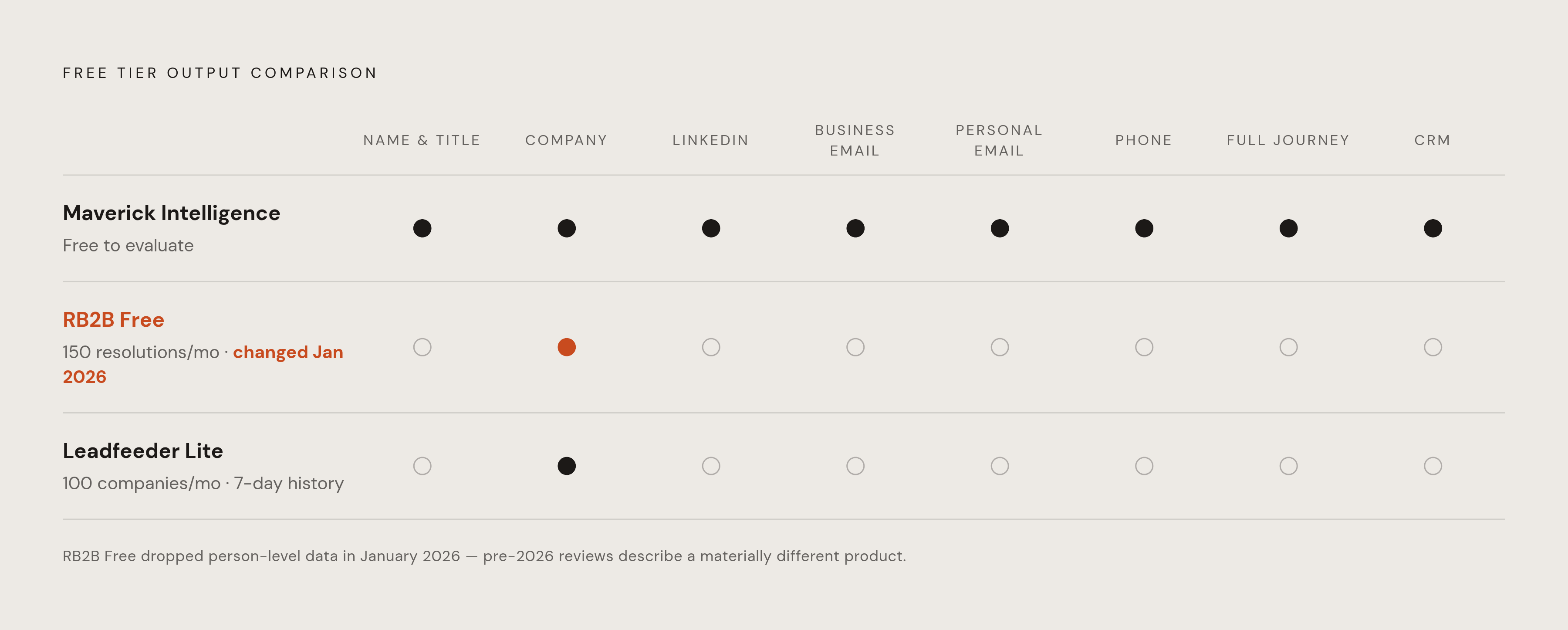
RB2B changed its free plan in January 2026 from person-level to company-level identification. Its free allowance now provides 150 resolutions/month, with Slack or Microsoft Teams as the only outputs. It includes no person-level profiles, email addresses, or CRM integrations. Founders relying on descriptions published before 2026 are therefore evaluating a materially different free product.
Starter costs $79/month for 300 resolutions and comes with person-level LinkedIn URLs. Pro costs $149/month for 600 resolutions and adds business email addresses and full integrations, including HubSpot, Salesforce, Clay, Zapier, webhooks, and CSV export. Pro+ costs $199/month and adds Premium Resolution to get higher match rates.
Identification is focused on US traffic, with thin coverage for European and APAC visitors. That makes the geography of investor targets and early customers a material constraint. The path to a named profile is straightforward, but it is no longer the free plan’s output.
Leadfeeder Lite is the durable free company-level option for European traffic or GDPR concerns
Leadfeeder Lite shows up to 100 identified companies per month, keeps data for seven days, and has no limit on users. Its European company-level coverage and GDPR-native posture make it relevant when person-level identification of European visitors is legally restricted. The seven-day history is a practical constraint because the free dashboard does not provide a lasting account-interest archive. How useful it is depends in part on how often the founder checks it.
The product identifies companies at every tier. It can therefore support account-based work, but it does not produce a queue of named contacts ready for outreach. For a founder whose immediate question is which firms are showing interest, that output may be sufficient. For direct investor or enterprise outreach, the research step remains.
Other options worth knowing include Albacross, Unify, and low-end paid entry points
Albacross has company-level identification that works well across Europe, along with credits for verified contacts. Its 14-day trial requires no credit card, but it is not a free-forever tier. Entry pricing is EUR 59/month billed annually, followed by EUR 149/month at the next tier and then custom pricing. It is relevant to European founders who prefer a European-headquartered vendor and need account identification with contact research support.
Unify combines website, research, and social signals with warm outbound sequencing. Its free tier has a cap on credits and three seats, and its paid plans start at $20/seat/month. The comparison therefore turns on whether sequencing is part of the founder’s need.
Vector has no free tier and starts at $399/month for 2,500 IDs, rising to $999/month for 10,000 IDs. Its distinguishing capability is native synchronization of identified contacts into paid ad audiences. At that minimum price, it is not a realistic pre-close option for most fundraising founders. Warmly is also outside the practical free category, with entry pricing now at $10,000/year post-acquisition and no free tier appearing on its pricing page.
Where every free plan breaks down is paid media attribution and CRM routing
The free-forever tiers reach their ceiling when a founder needs to connect identity to paid campaigns and automatic CRM follow-up. Identifying a company does not show which named person arrived through an ad. Sending a notification does not create a routed CRM record. Free evaluation of a broader product is a different proposition from a continuing free plan with these limits.
Attribution links the identified visitor to the campaign that brought them, while hashed email and phone matches can be sent to Meta Custom Audiences, Google Customer Match, and LinkedIn Matched Audiences. Those audiences let founders retarget identified visitors or leave them out of spending on cold acquisition. Match confidence matters because matches based on verified email and household matches work differently from those based on device fingerprints and inference. Blending confidence tiers into one export can produce underperforming audiences.
CRM routing creates a separate operational cost. Leadfeeder Lite has no CRM integration, while Salesforce, HubSpot, Pipedrive, Microsoft Dynamics, and Zoho integrations are paid features. A native integration and a Zapier connection are not equivalent because the latter requires someone to build, map, and maintain a Zap. During fundraising, that maintenance competes with follow-up time. A free identification feed is therefore a starting point for an acquisition workflow.
How to choose the right free tier — or decide when the step-up to paid is worth it before the round closes
The decision rests on three variables, namely traffic geography, the need for a person or an account, and follow-up speed. For US-majority traffic where direct outreach is urgent, Maverick Intelligence is the strongest first evaluation because it joins contact enrichment to journey and acquisition context. RB2B’s paid tiers offer another route to person-level output. For EU/UK-majority traffic, company-level identification is the right option to compare because GDPR limits the legal use of person-level identification. Mixed traffic can justify a two-tool approach, with person-level coverage for US sessions and company-level coverage for the European segment.
The required output should then decide whether free is sufficient. Company names can be enough for account-based marketing and reporting, but investor relations, enterprise sales, and partnership outreach need named contacts. Speed matters when having to do research or routing by hand keeps those contacts from reaching a workflow. A free plan that reveals interest but leaves it untouched has not solved the founder’s pipeline problem.
A paid step-up becomes worth considering when the monthly cap of 100–150 identifications is reached in the first two weeks. It is also worth a look when company names fail to convert because no one does the contact research, or when paid campaigns run with no link between what was spent and the visitors identified. The $79–$149/month person-level step-up can save a research task that costs more in the founder’s time than the subscription costs. Before committing, run the 30-day audit on free access. The deciding figure is the usable match rate on the founder’s own traffic.